

Home / Prevention / IHHT
Supportive therapy
The therapy
The aim of IHHT is to gently challenge the body with brief, controlled changes in the amount of oxygen it receives, so that it adapts and becomes more resilient — much as the body adapts to high altitude.
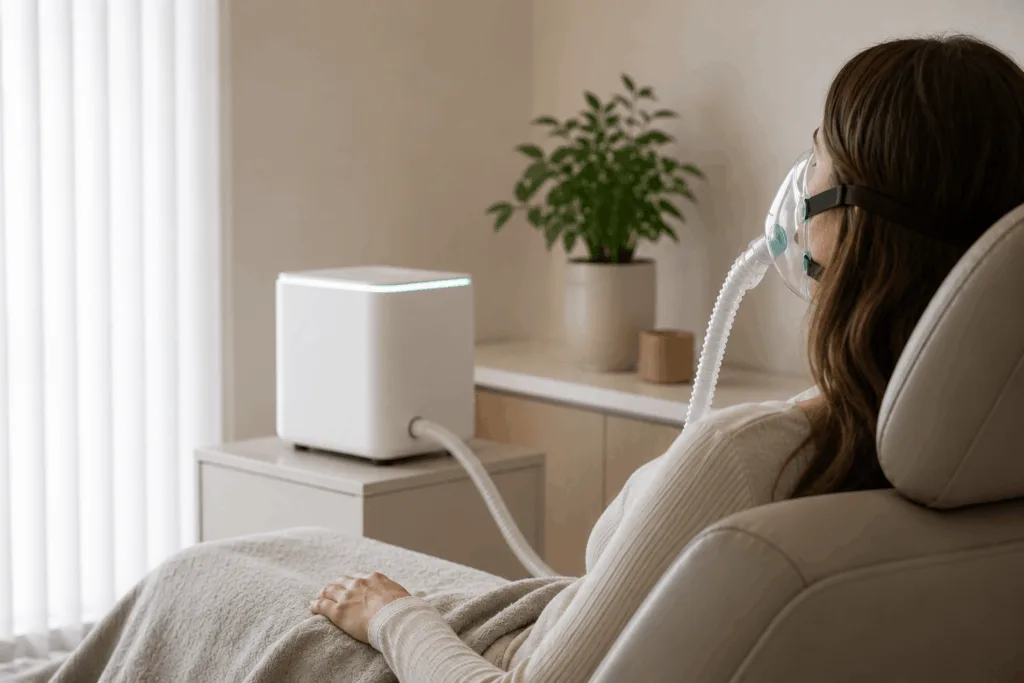
During a session you breathe through a comfortable mask that alternates between air containing less oxygen than usual and air containing more oxygen than usual. The lower-oxygen phases act as a mild, manageable stimulus: the body notices the reduced supply and responds by adapting to use oxygen more efficiently. The higher-oxygen phases in between allow the body to recover, which keeps each session gentle and comfortable.
Repeated over a course of sessions, this controlled stimulus is intended to support the body’s own adaptive responses — encouraging more efficient use of oxygen, supporting circulation, and the healthy function of the mitochondria, the parts of the cell that turn oxygen into usable energy.
Because IHHT works by prompting the body’s own adaptation rather than by treating a specific illness, it is used as a preventive and supportive therapy — part of a wider approach to energy, resilience, and healthy aging.
Throughout the session, the air you breathe alternates between lower-oxygen and higher-oxygen phases, each lasting a few minutes.
As a preventive and supportive therapy, IHHT has been considered in contexts including:
QUALIFICATION
IHHT is introduced only after a medical assessment. The treating doctor reviews your medical history, current health, any existing conditions, and your goals for the therapy. Because IHHT involves controlled periods of reduced oxygen, certain conditions may make it unsuitable — which is one reason this assessment is carried out beforehand.
If IHHT is considered appropriate and no contraindications are present, an individual plan is prepared, and the therapy is carried out under supervision and adjusted to suit you. It is intended to complement, not replace, other medical care.
frequently asked questions
Not quite. Oxygen therapies aim to give the body more oxygen. IHHT does something different: it alternates between lower and higher oxygen levels, using the brief lower-oxygen phases as a gentle stimulus the body adapts to. The goal isn’t simply more oxygen, but a controlled challenge the body can respond to.
The lower-oxygen phases are mild and closely monitored — comparable to the air at altitude, not a sensation of breathlessness. Your oxygen levels are tracked throughout, and the therapy is kept within a range that stays comfortable for you. Most people find the session relaxing.
IHHT is usually carried out as a course rather than a single session. After reviewing your health and goals, your doctor will suggest a plan and discuss it with you.
The session is non-invasive and most people can go straight back to their normal routine. Some may feel a little tired afterwards, particularly in the first few sessions, so it’s worth asking your doctor what to expect in your case.
IHHT is generally well tolerated when it’s carried out under medical supervision, with continuous monitoring and a protocol set individually for each patient. It begins only after a medical assessment has confirmed that it’s suitable and ruled out any reasons not to proceed.
We speak English, Polish and German.